About Us
The Market Teaches Tools.
We Teach the Discipline That Makes Them Pay Off.
Every AI training program, certification body, and university on the market today is competing on the same axis: who can teach the newest tools, the latest models, and the freshest capabilities the fastest. The entire industry has optimized for tool literacy. And the results speak for themselves. Between 70 and 95 percent of organizations that have invested in AI report they are not achieving their desired ROI.
The problem is not the tools. The problem is that tool literacy and deployment discipline are not the same thing. One teaches you how to operate what is in front of you. The other teaches you how to build something that delivers measurable value, survives the next technology shift, and keeps humans accountable at every decision point that matters.
PrecisePoints was built to teach the second discipline. We define this as Successful Deployment Execution Competency: the structured ability to take an AI initiative from concept to measurable production outcome, with ROI, human accountability, and architectural durability built in from the start. We are The Only Learning Brand Built for AI Deployment Execution. That is not a positioning statement. It is a structural fact. No other certification body, university program, or training provider has built a curriculum around this specific gap.
That gap has three dimensions. We call them the Three Foundational Pillars. Understanding what they are, why they matter, and why the market has ignored them is the fastest way to understand what makes PrecisePoints different.
Meet the Managing Partners.
Click any card to learn more about the people who built PrecisePoints and lead its work every day.

Lynsi shapes the vision behind PrecisePoints and ensures everything the company builds stays true to its core purpose. She brings a rare blend of learning design, strategy, and real-world execution to the table, drawing from years of leading global training initiatives and building scalable education models.
She focuses on how ideas become real, measurable outcomes, guiding the evolution of the AI-DaaS (AI Deployment as a Service) framework and ensuring every solution helps organizations close the gap between AI ambition and actual deployment.

Brian drives how PrecisePoints connects with the market and turns insight into meaningful partnerships. He brings a relationship-first mindset shaped by years of leading growth, sales strategy, and business development across competitive industries.
He focuses on understanding where organizations struggle with AI deployment and helping them move forward with clarity. His work ensures that every conversation leads to practical next steps and long-term value, not just ideas.

Dr. Milton Mattox focuses on turning complex AI concepts into systems that actually work in production. He leads the design of the learning architecture behind PrecisePoints, ensuring that every framework, lab, and certification translates into real capability and measurable ROI.
His approach centers on practical execution. He builds environments where teams do not just learn AI, they apply it, test it, and deploy it with confidence in real-world scenarios.
The Three Disciplines That Determine Whether AI Pays Off.
These are not topics in a module. They are the three disciplines that determine whether an AI initiative reaches production, delivers measurable value, and holds that value as the technology underneath it keeps moving.
The standard approach to AI ROI is retrospective. Organizations build an initiative, launch it, and then measure whether it delivered value. When it does not, they adjust the measurement. They add new KPIs. They reframe the success criteria. What they rarely do is go back and ask whether the initiative was worth building in the first place.
ROI by Design flips that sequence. Value is a structural input to the deployment decision, not a metric tracked after the fact. Before a single resource is committed, learners are trained to ask: what is the specific business outcome this initiative must produce, what is the measurable value threshold it must clear, and what happens to the deployment decision if it cannot clear that threshold?
This is not financial modeling. It is deployment discipline. The organizations that consistently achieve AI ROI are not better at measuring. They are better at building. They select initiatives that have a clear value case before they begin, and they structure the deployment to produce that value by design.
Human-in-the-Loop is one of the most misunderstood concepts in enterprise AI. Most organizations treat it as a compliance requirement: a checkbox that satisfies governance obligations and reduces liability exposure. That framing turns human oversight into friction.
The organizations that outperform their peers treat HIL as a competitive capability. Human oversight, positioned precisely at the decision points where it adds the most value, does not slow AI systems down. It makes them more accurate, more defensible, and more trusted by the people who depend on them.
HIL as Strategy teaches organizations to map their AI systems against a decision boundary framework: which decisions should AI make autonomously, which require human confirmation, and which must remain entirely in human hands. That mapping is a performance architecture decision, not a governance exercise.
Pattern-First AI Deployments is a deployment architecture that structures AI systems around stable business patterns rather than specific tools, models, or vendors. It resolves one of the most persistent risks in enterprise AI: the cost and disruption of replacing the execution layer when models shift, vendors change, or infrastructure evolves.
The architecture operates across three layers. The Pattern Layer defines business workflows, functional intent, outcome requirements, governance logic, and human-in-the-loop checkpoints in business language. It does not change when the AI market shifts. The AI Agnostic Control Layer governs model routing, prompt transformation, orchestration, policy enforcement, and observability. It translates stable business patterns into execution instructions and absorbs market volatility. The Execution Layer contains models, APIs, agent frameworks, and infrastructure. It is intentionally replaceable and is not the source of durable value.
The governing design rule is absolute: patterns must never reference tools directly. When that boundary holds, the architecture is enforceable. When it collapses, the system reverts to a tool-first implementation with added complexity. Every design review and governance audit should validate this rule as a first-order condition.
The primary measurable outcome is Swap Cost Compression. In tool-first deployments, replacing the execution layer can consume 40 to 70 percent of the original implementation budget. In a Pattern-First architecture, that cost is bounded by design. Organizations update one layer rather than rebuilding the system.
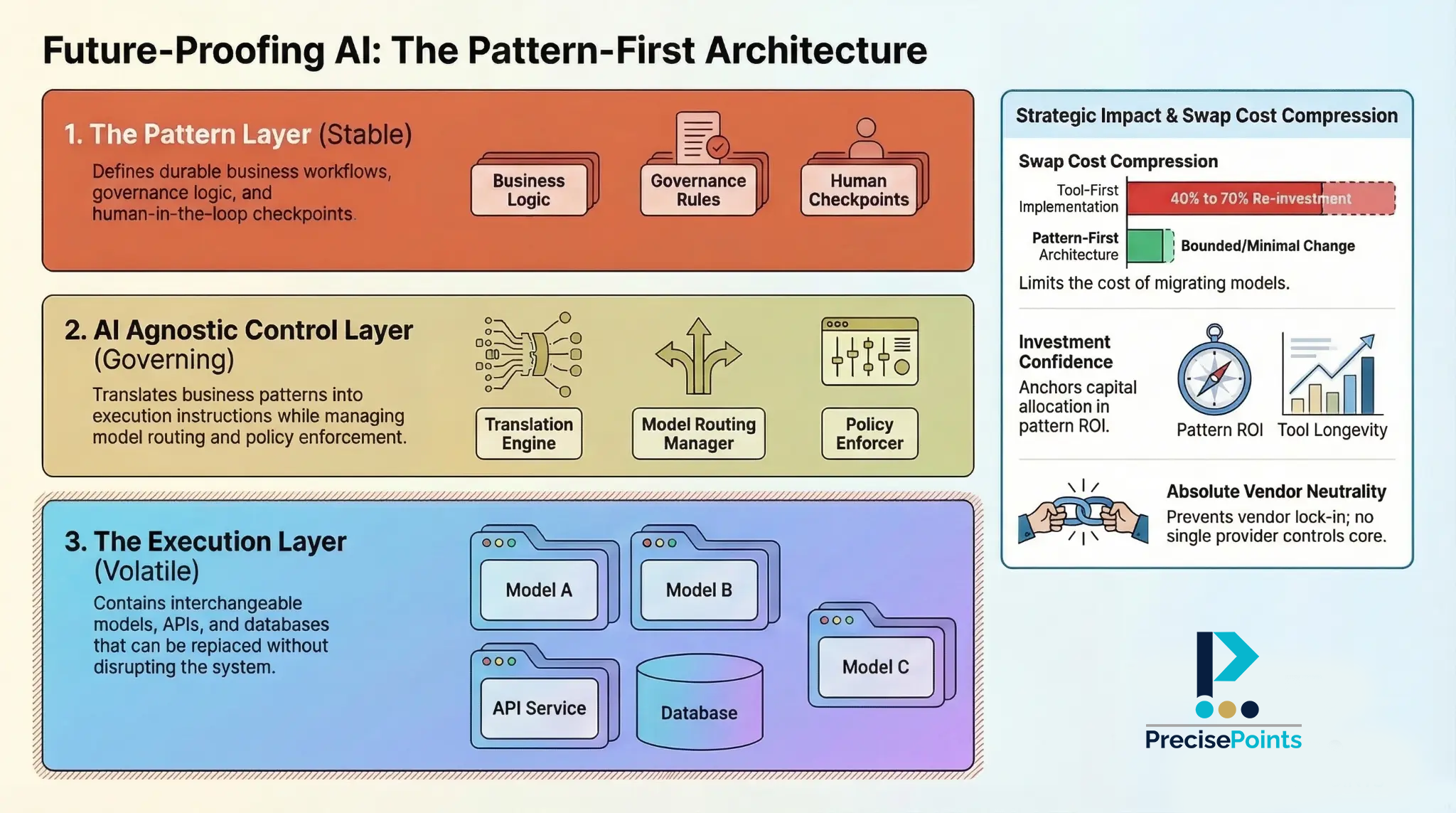
The three-layer Pattern-First architecture. The Pattern and Control layers are durable. The Execution Layer is intentionally replaceable.
We Are Not Loud. We Are Not Trendy. We Are Not Just Another EdTech Company.
We do not chase the model of the month. We do not build curriculum around vendor announcements. We do not award credentials for awareness. Every program we offer is built on one question: can this person or team now execute a production-grade AI deployment that delivers measurable value?
The market teaches tool operation. We teach Successful Deployment Execution Competency. That is a separate discipline, and it is the one that determines whether the investment ever pays off. No other learning brand was built exclusively to close this gap. We were.
We are precise. We are verifiable. We are the standard.
Explore Our CertificationsTake the 90-Second Diagnostic Before You Decide.
If you are deciding between certification, custom training, or a direct conversation, start with the diagnostic. It gives you a quick score, a stage-based interpretation, and a sharper path forward.